
The Third Place That Never Left


The café has been discussed to exhaustion. Every writer who has ever spent a morning in Paris or a weekend in a city that is not their own has filed the same dispatch: the marble tables, the espresso, the particular quality of light, the sense that everyone around you is thinking about something worth thinking about. The café as third place, as the room between work and home where the self quietly recalibrates, has been written about so thoroughly that the genre has become its own kind of noise.
The bookshop has not been discussed to exhaustion. It should be.
In city after city, the independent bookshop has become the place where a certain kind of person goes not necessarily to buy books but to be in a room with other people who take things seriously. The distinction matters. The bookshop is not a café. You are not there to be seen. You are not there to work on your laptop with your noise-cancelling headphones on and your back to everyone else. You are there because you want to be surrounded by the evidence that human beings have had things worth saying, and because being in the physical presence of someone else who is thinking the same thing is, in 2026, a rarer and more necessary experience than it has any right to be.
Three cities. Three rooms. What they share.
Paris
France is the only country in the developed world that has managed to protect its independent bookshops from the logic of the market, and it did so with legislation. The Loi Lang of 1981 capped discounts on new books at five per cent, making it impossible for online retailers to undercut the corner library by forty per cent and call it progress. The result is that Paris has four hundred bookshops, more per capita than anywhere else in the world, and they have not merely survived but developed distinct identities that no algorithm could replicate.
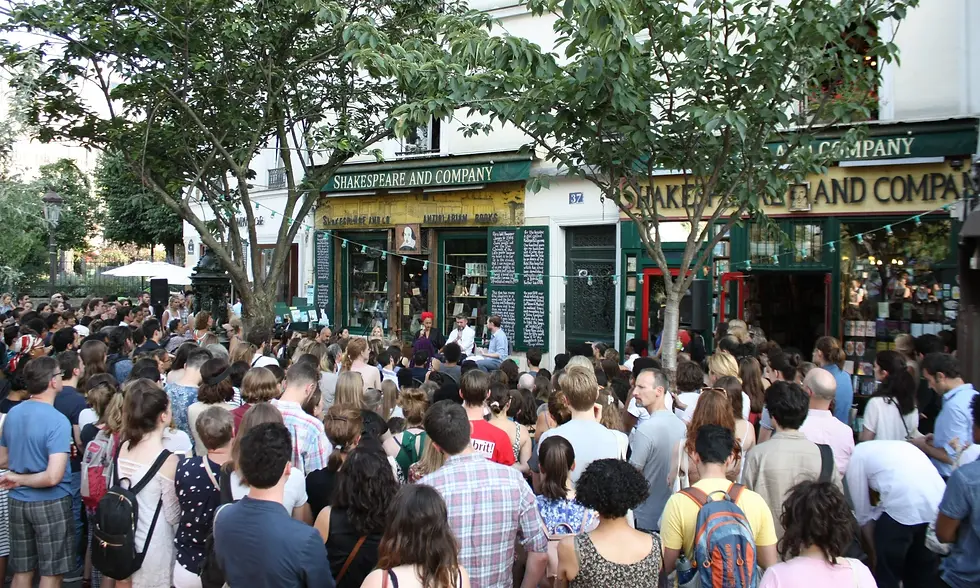
Shakespeare and Company on the Rue de la Bûcherie is the landmark, and it earns that status. Since George Whitman opened it in 1951, named by Sylvia Beach as the spiritual successor to her own shop that first published Joyce's Ulysses, it has been a meeting place for writers and readers in a way that very few places in any city have managed. Go once. Stand in it. Understand why it matters. The labyrinth of alcoves and reading nooks is the point, and the sense of accumulated literary history is genuine rather than performed.
For a bookshop you might actually buy something in without feeling like a tourist at a monument, go to the Red Wheelbarrow. Tucked just beside the Luxembourg Gardens, it is a real working English-language bookshop run by people who have read the stock and have opinions about it. Quieter, more considered, and considerably easier to browse without elbowing anyone. This place has the feel of the old Beat headquarters in San Fransisco, City Lights.
Another less obvious answer, and the one more worth your time on a second or third visit, is Galignani on the Rue de Rivoli, the first English bookshop established on the continent, opened in 1801, with its dark wood, its Tuileries-facing windows, and a selection of art and literature books so carefully considered it reads less like retail than like an argument. No one is performing anything at Galignani. Everyone who enters lowers their voice slightly. This is the correct response to the room.
New York City
New York's bookshops are organized by conviction rather than neighborhood, which reflects something true about the city. Three Lives and Company on West 10th Street in the West Village has operated since 1968 from the ground floor of a brownstone with a red door that has become one of the most photographed facades in the city. The locals have made it their living room in a way that is not metaphorical. The booksellers have worked there for decades and have the particular authority of people who have read everything in the room and have opinions they are not afraid to share.

For something more eccentric and perhaps more representative of what the independent bookshop can be at its most particular, there is Mast Books in the East Village. Monocle described it as defying categorization entirely: no labelled sections, no promotional signs, a selection that ranges from a memoir of a graffiti artist to a survey of the photographer Luigi Ghirri, with the connecting thread being the personal taste of its co-founder. If you like one thing in the store, he said, there is a good chance you will find a way to like almost everything. That is the bookshop as a statement of belief rather than a commercial proposition. It is a harder thing to sustain and a more valuable thing when it works.
Albertine, on the Upper East Side in the Payne Whitney mansion, occupies the opposite end of the scale. Opened by the French Embassy's Cultural Services, it carries over fourteen thousand titles in French and English from thirty French-speaking countries, beneath a hand-painted ceiling of constellations. The room is extraordinary. What it offers beyond the room is the particular pleasure of a bookshop that takes seriously the idea that thinking happens in more than one language, and that a reader who exists only within their own literary tradition is a reader who is missing most of what has been said.
London
London's independent bookshops are worth paying attention to right now. The British Book Awards named Backstory in Balham the best independent in London for 2026, and the reason is instructive. Backstory is a bookshop and a wine bar, opened by a former Economist journalist who left a successful career to do something he considered more useful. The wine bar is not a gimmick. It is a commitment to the idea that the bookshop should be a place you stay rather than a place you visit. The shelves are serious. The wine is good. The combination produces an atmosphere that is extremely difficult to manufacture and impossible to find on the internet.

Daunt Books on Marylebone High Street is the longer established version of the same argument. Built in 1912 as London's first purpose-built bookshop, it organizes its books by country rather than genre, which means that finding a novel about Italy requires you to walk past the history, the travel writing, the cookbooks, and the architecture. You arrive at the novel knowing something about where it was written. The shop makes the argument, quietly and through its architecture, that context is not optional.
The common thread across all three cities is not the size of the stock or the quality of the coffee or even the curation, though all of those things matter. It is that each of these shops has a point of view. A belief about what is worth reading and why. The best bookshops are not neutral. They are not trying to have something for everyone. They are trying to have the right things for people who are paying attention.
Paying attention is the scarcest resource in any city right now. The bookshop has been asking people to do it for centuries. It did not need to be rediscovered. It just needed to be noticed again.



Comments